Built on open data from CelesTrakNASA/JPL HorizonsMcDowell GCATThe Space DevsWikimedia Commons
Explore
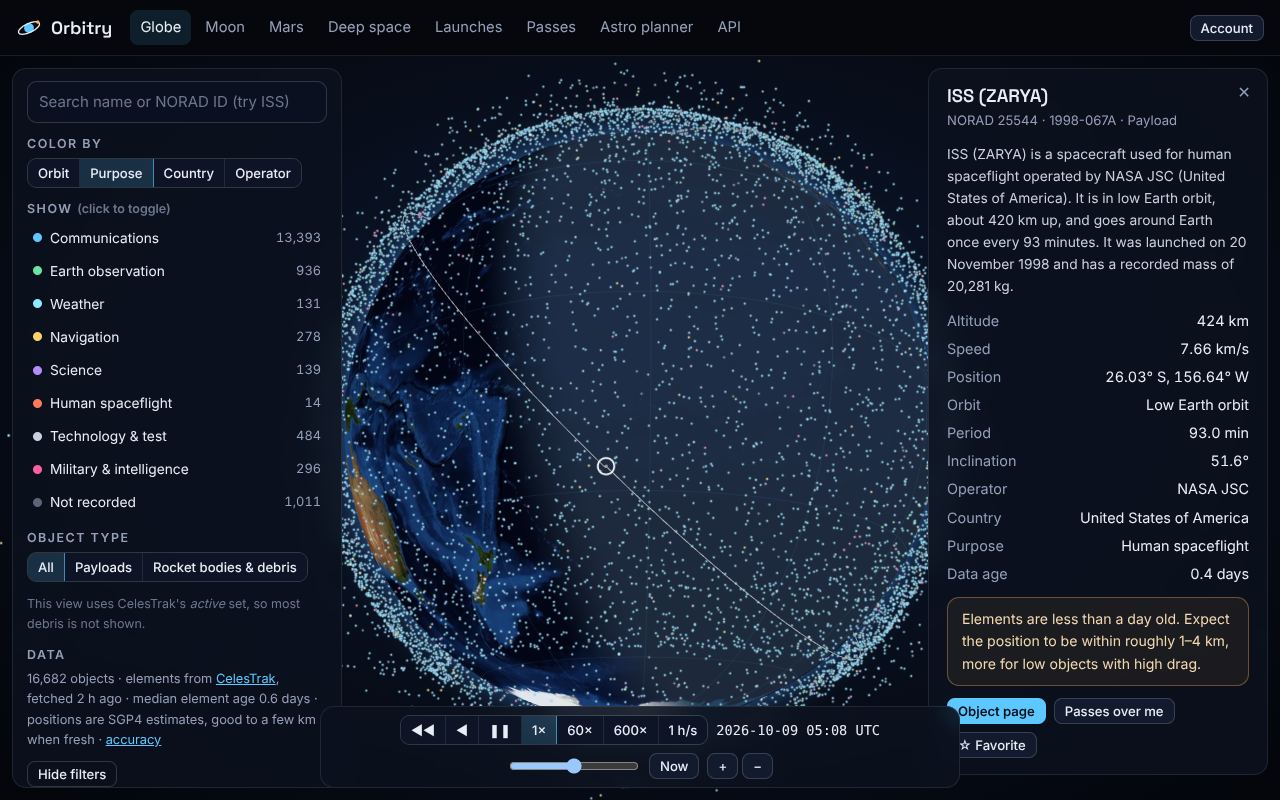
A live globe of Earth orbit
Every publicly tracked active satellite, positioned in your browser from the latest orbital elements.
- Color by orbit, purpose, country or operator
- Search by name or catalog number, then follow its orbit
- Rewind or fast-forward up to three days
- Each object shows its data age and an accuracy estimate
Beyond Earth
The Moon, Mars and deep space
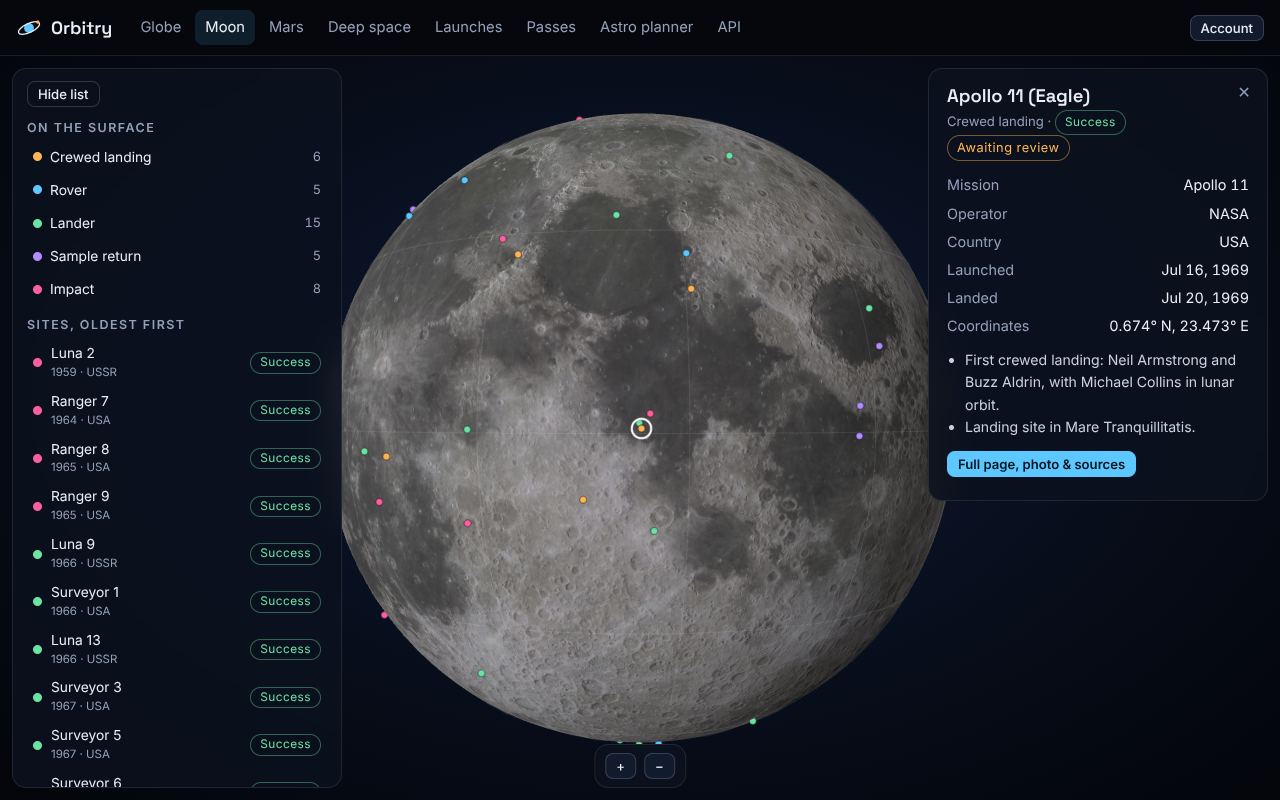
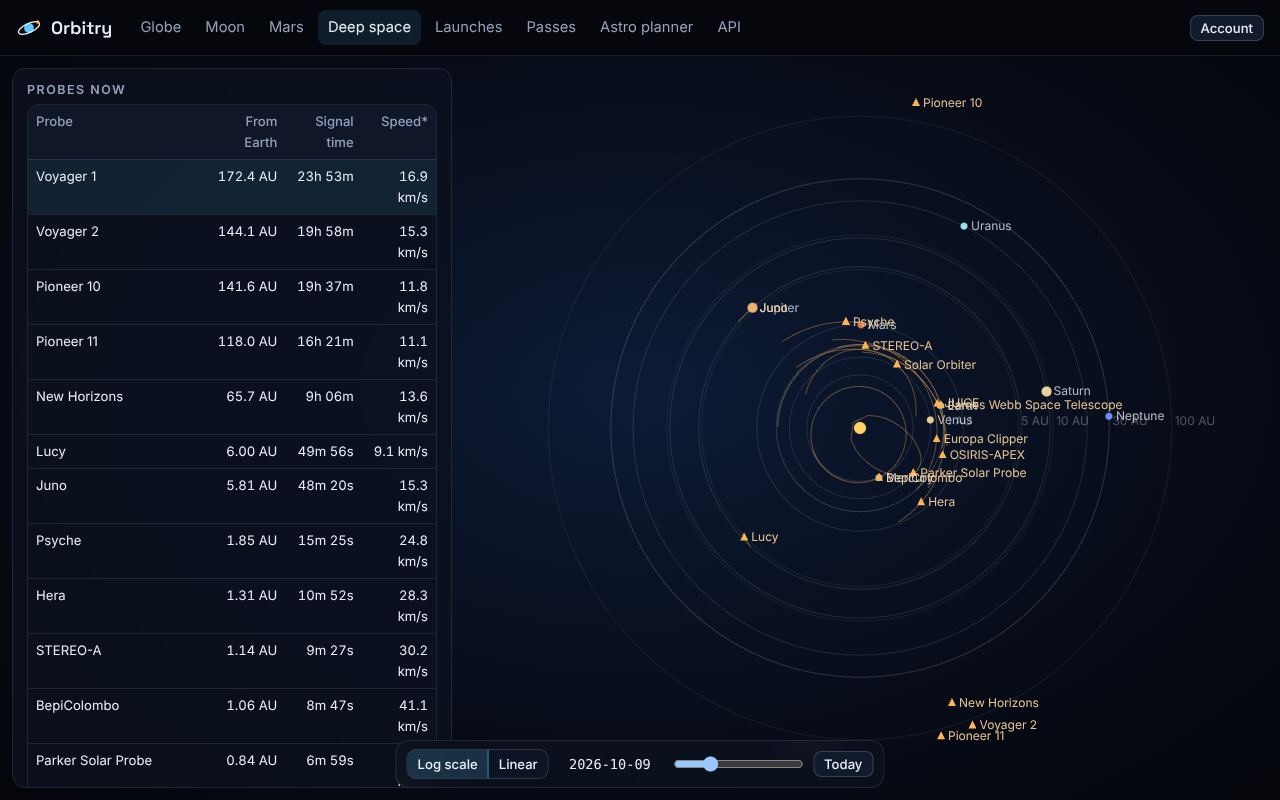
From Luna 2 in 1959 to the landers of 2025: every landing and impact site, with mission dates, outcomes and sources. Out past the planets, the Voyagers, New Horizons and Parker Solar Probe, with live distance, speed and signal travel time from NASA/JPL Horizons.
Look up
Know when to step outside
Pass predictions for your location: when the ISS, the Chinese space station, a fresh Starlink train or any satellite crosses your sky, which way to look, how high it climbs and, where it can be estimated, how bright it will be.
Find passes near me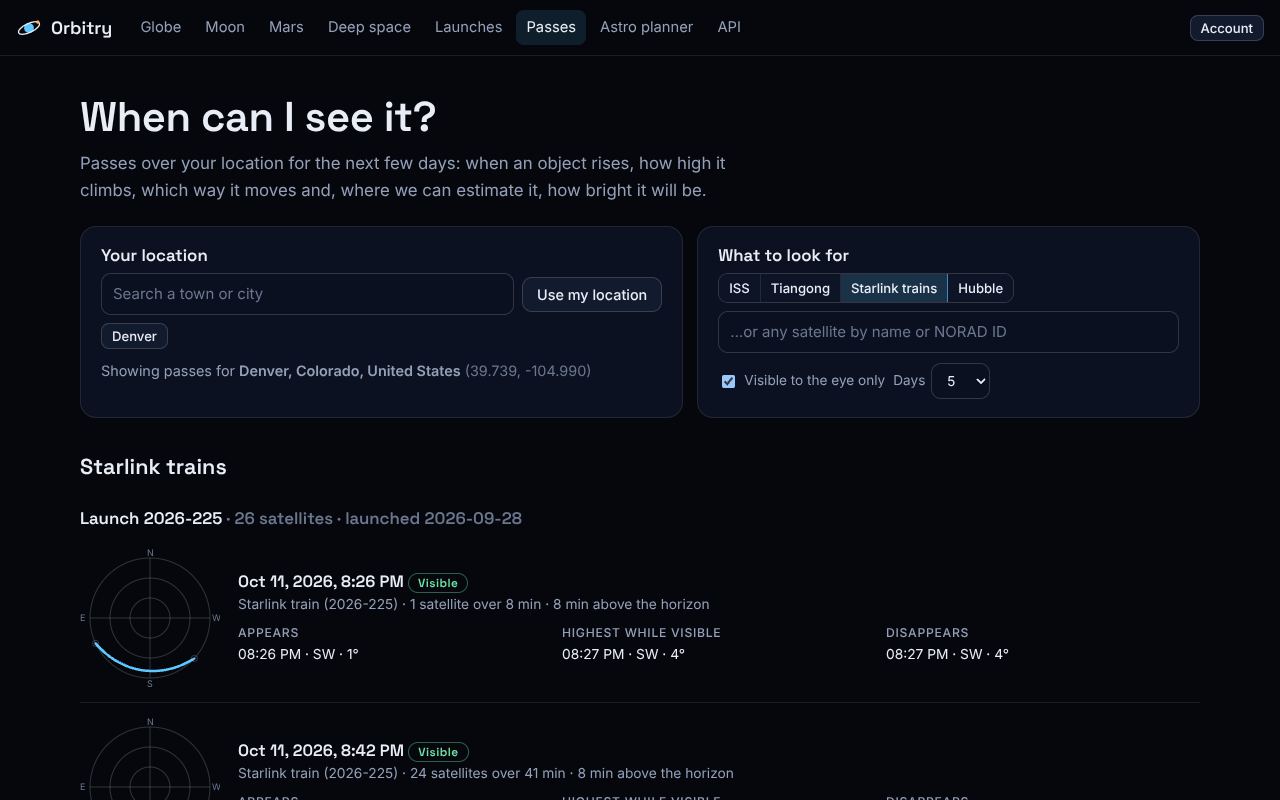
Every object, explained
A page for each object
Key facts, orbit, a live ground track, a freely licensed photo and a NASA 3D model where one exists, with the licence of every image recorded and the sources one click away.
See the ISS page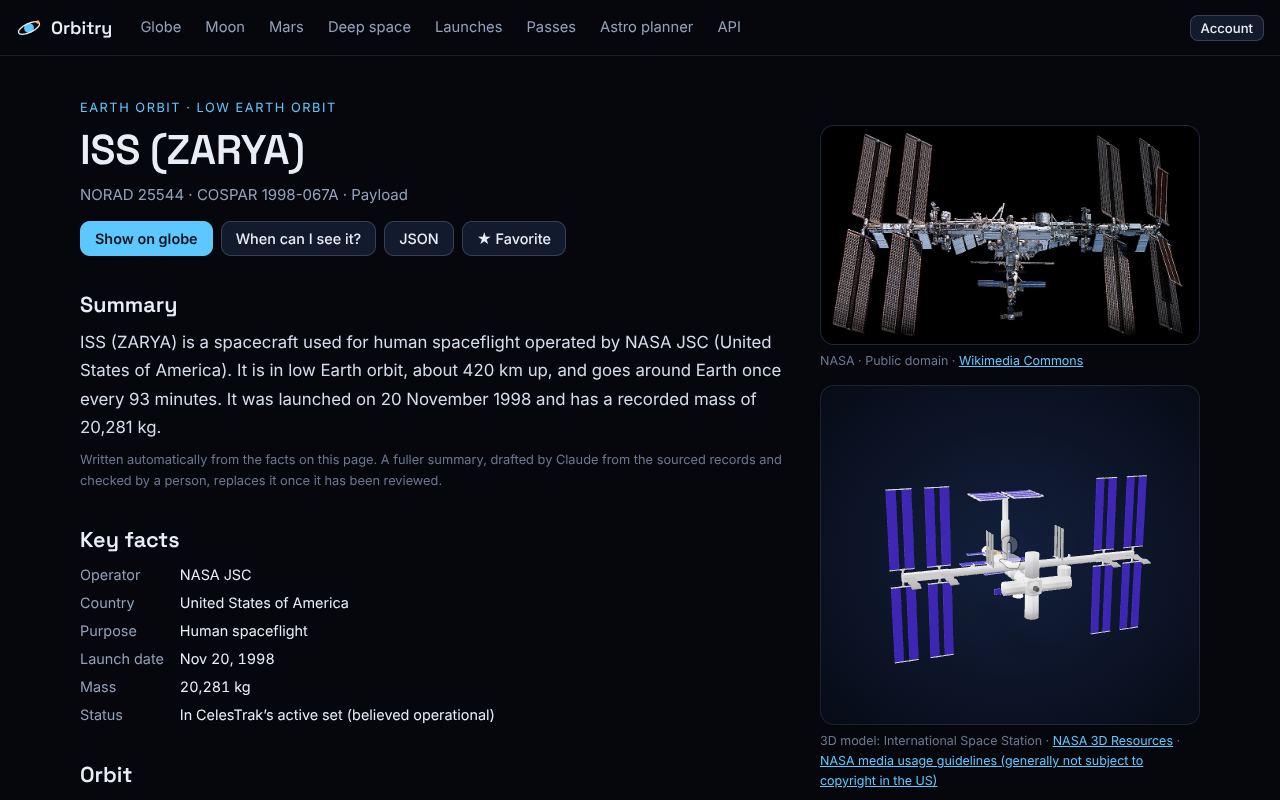
For astrophotographers
Warnings before a satellite streaks your frame
The planner combines darkness, the Moon, the cloud forecast and your horizon to rank what to shoot tonight. Then it checks every tracked object against your exact field of view, exposure by exposure, and tells you which frames will catch a sunlit satellite.
Open the planner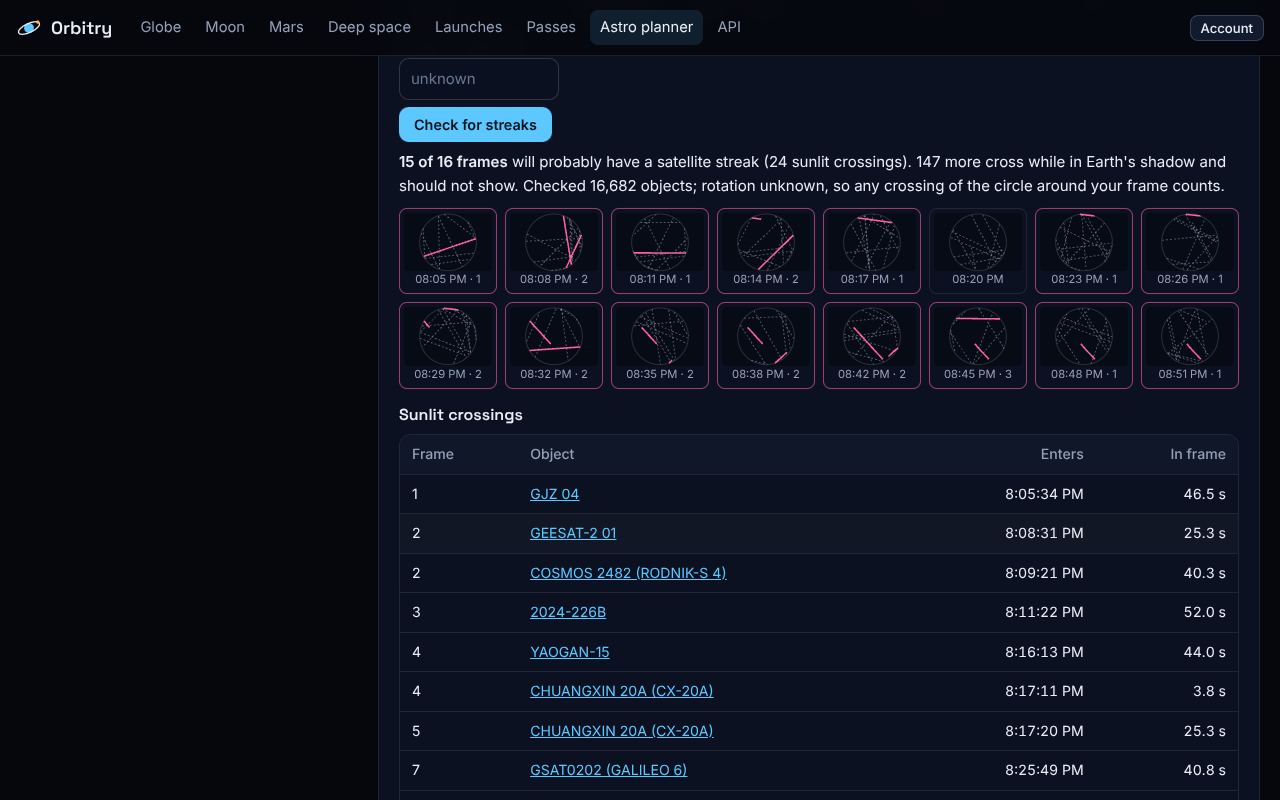
For developers, classrooms and newsrooms
An open API and embeddable globes
The merged catalog as clean JSON, from low Earth orbit to the surface of Mars: objects, live positions, passes, landing sites, deep-space probes, launches and re-entries. Free with attribution. Teachers and publishers can drop a live globe into a lesson or an article with one line of HTML.
Read the API docsGET /api/v1/objects/25544/passes?lat=51.5&lon=-0.1&visible_only=true
<iframe src="https://orbitry.net/embed/?color=purpose&norad=25544"
width="100%" height="480" title="Live satellite globe"></iframe>Who it's for
Anyone who has ever looked up
Students and teachers
A real, current picture of space to explore in class, with sources students can follow.
Newsrooms
Launches, re-entries and embeddable globes for stories, with data age stated alongside.
Developers
One catalog from Earth orbit to Mars, already merged and cleaned.
Astrophotographers
Tonight's plan, plus warnings before a satellite crosses an exposure.
The curious
What that moving light was, and when it comes back.
Accuracy
Real data, with its limits stated
Computed, not guessed
Satellite positions come from published orbital elements run through SGP4, the standard model made for them. Good to a few kilometres when fresh, for visualising and timing passes, not for collision avoidance.
Data age on every view
Every object shows how old its orbital data is and roughly how far off its position may be. Records still awaiting review are labelled.
Every source credited
Each fact, photo and model links to where it came from, with its licence. Unlicensed images are left out, not guessed at.
Where things stand
What's live, and what's next
Live today
- LiveEarth-orbit globe with search and time travel
- LiveMoon, Mars and deep-space views
- LiveLaunch and re-entry feed
- LiveObject pages with photos, models and sources
- LivePass predictions, including Starlink trains
- LiveEmbeddable globes
Built and launching
- LaunchingFree accounts with saved places and pass alerts
- LaunchingPublic API with free and Pro keys
- LaunchingAstrophotography planner with streak warnings and a nightly email
- LaunchingAsk Claude about any object, answered only from its sourced record
- NextClaude-drafted, human-reviewed summaries for notable satellites
Start with the sky above you.
Questions, partnerships or press: crice@orbitry.net